When to Consider Referring for an APD Evaluation
The ASHA technical report on (central) auditory processing disorders identifies the audiologist as the professional responsible for APD diagnosis, while SLPs play a critical role in identifying candidates and providing intervention. A referral for an APD evaluation is appropriate when the following clinical picture emerges and a peripheral hearing loss has been ruled out or already documented:
Acoustic / Perceptual Indicators
- Difficulty understanding speech in noise that is disproportionate to hearing thresholds
- Mishearing phonetically similar words despite adequate vocabulary knowledge
- Inconsistent responses to auditory input, performs better one-on-one than in groups
- Notably worse performance when speech is presented at normal conversational rates or with minimal acoustic redundancy
- Difficulty with binaural listening tasks (e.g., attending to one speaker when multiple are present)
Language / Academic Profile Indicators
- Phonological awareness deficits that are not adequately explained by language disorder alone
- Persistent difficulty with auditory discrimination despite targeted SLP intervention
- Spelling errors suggesting auditory confusion (wrong phoneme substitutions rather than omissions)
- Poor auditory memory or auditory sequential recall relative to visual memory
- History of chronic otitis media with effusion in early childhood
- Unexplained gap between auditory and visual learning modes
Note on sequencing: ASHA recommends that a comprehensive hearing evaluation precede APD testing. If your client has not had a recent audiological exam (within 12 months), we will conduct this as part of the appointment. If you have existing audiometric data, please fax it ahead so we can factor it into the evaluation planning.
APD vs. Language Disorder: Where the Diagnostic Line Falls
One of the most clinically complex questions in pediatric audiology is where auditory processing disorder ends and a primary language disorder begins, particularly because the two frequently co-occur. The distinction matters for treatment planning, even when both are present.
Language Disorder (SLP scope)
- Difficulty with semantic, syntactic, or morphological processing
- Comprehension deficits apply across visual and auditory modalities
- Vocabulary and grammar knowledge gaps are primary
- Performance does not significantly worsen with acoustic degradation
- Typically stable across listening environments (quiet vs. noisy)
Auditory Processing Disorder (Audiology scope)
- Difficulty specific to how the brain decodes and organizes auditory signals
- Comprehension is notably worse in noise, at speed, or with degraded signals
- Vocabulary and grammar knowledge may be adequate; the access route is the problem
- Performance is environment-dependent, significantly better in quiet one-on-one settings
- Often passes standard school hearing screening despite reported difficulty
Clinically, a child may have both. When SLP intervention has produced plateau or inconsistent results, particularly when auditory-specific tasks like phoneme discrimination, rapid speech processing, or binaural listening are the persistent weak points, an APD evaluation can provide the differential data needed to adjust the intervention focus.
What the APD Evaluation Covers
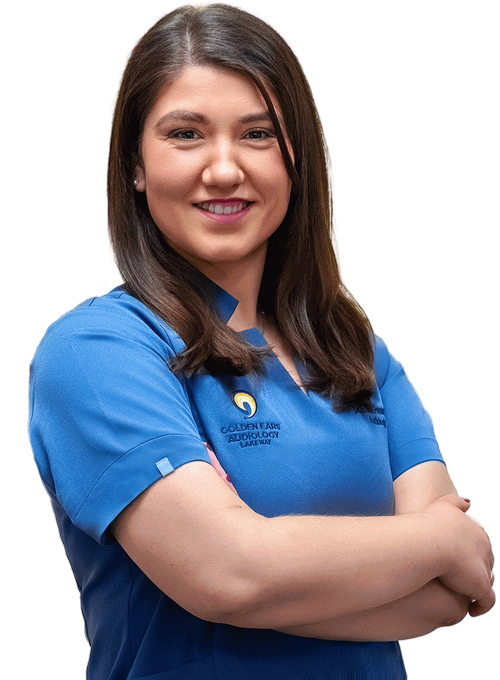
The evaluation at Golden Ears Audiology uses a full battery of standardized tests administered by Dr. Sonia Penaroza, Au.D. The battery is selected based on the referral profile and always begins with a complete pure-tone and speech audiometric evaluation to establish baseline hearing sensitivity.
Complete Hearing Evaluation
Pure-tone audiometry, speech recognition thresholds, word recognition in quiet, and tympanometry. This establishes that any subsequent APD findings are not attributable to peripheral hearing loss.
Dichotic Listening Tasks
Competing words or sentences presented separately to each ear simultaneously. Measures binaural integration and separation, areas frequently impaired in children with APD who struggle in noisy classrooms.
Temporal Processing
Gap detection and temporal pattern tasks measure how accurately and quickly the auditory system processes rapid acoustic changes. Temporal processing deficits are strongly associated with phonological awareness difficulties.
Monaural Low-Redundancy Speech
Speech presented at reduced intelligibility (filtered, time-compressed, or in noise) to assess how well the auditory system uses available cues to reconstruct the signal. Reveals deficits not visible on standard word recognition tests.
Binaural Interaction Tasks
Assesses how the two ears work together, including Masking Level Difference (MLD) and binaural fusion tasks. Relevant for children who perform inconsistently when listening conditions change.
The full appointment is approximately 90 minutes for pediatric cases. For a clinical overview of all four APD subtypes, see the APD evaluation page.
After the Evaluation: What the Report Includes
Parents receive preliminary results on the same day. The formal written report, delivered within approximately 7 to 10 business days, is designed to be useful to the entire clinical team:
Full Test Scores With Interpretation
All subtest scores with normative comparisons, an interpretation of which APD subtype(s) are present, and a clinical summary written in accessible language for parents, plus technical detail usable by treating clinicians.
SLP-Relevant Recommendations
Where APD findings have implications for SLP treatment (e.g., phonological processing intervention, auditory discrimination goals, pacing adjustments), these are noted explicitly. The report is designed to inform, not replace, your clinical judgment.
School & IEP Accommodation Recommendations
For school-age children, the report includes specific evidence-based classroom accommodations. These can be used directly by schools to support 504 or IEP documentation, and supplement what the SLP may already have recommended.
Coordination With Your Team
With parent authorization, the report can be shared directly with you, the school IEP team, or the child's pediatrician. We are available by phone to discuss findings and clinical questions. Dr. Penaroza welcomes collegial consultation.
How to Refer a Client
No formal referral form is required, families can self-schedule, and many do after an SLP recommends it. If you prefer to make the referral directly, or want to ensure we have your clinical context before the appointment, use any of the following methods:
Call
(512) 222-6880
Mon–Fri, 8am–6pm. Mention you are referring as an SLP and we will note the clinical context in the chart and prioritize scheduling coordination.
Fax
(512) 631-4188
Fax a referral letter, evaluation summary, or any prior audiological or speech-language data you want included in the pre-evaluation context. We will contact the family directly to schedule.
Referral Form
Download the professional referral form from our physician referral page. It applies equally to SLP and therapy referrals. Complete and fax or email to [email protected].
What to include with your referral
- A brief description of the child's presenting concerns and your clinical impression
- Results of any prior hearing evaluations (within 12 months preferred)
- Relevant assessment data, CELF, EVT, GFTA, phonological awareness battery results, etc.
- Any prior psych or neuropsychological evaluations, if available
- School reports or teacher observations if you have them
This context helps us select the most appropriate test battery and write a report that integrates meaningfully with your findings.
Frequently Asked Questions From SLPs
The standard APD test battery requires a child to be at least 6 years old. Most testing is performed on children ages 7 and older, when results are most reliable and clinically interpretable. Some developmentally ready 6-year-olds can complete the battery, Dr. Penaroza makes this determination at the time of the appointment. For children under 6, a comprehensive hearing evaluation and continued SLP intervention targeting auditory discrimination are the appropriate first steps.
No. If the child has not had a recent comprehensive hearing evaluation, we perform one as the first part of the appointment. A current peripheral hearing evaluation is required before APD test scores can be interpreted, and we ensure this is completed regardless of prior history. If you do have recent audiometric data, faxing it ahead saves time and helps us prepare the appropriate test battery.
Yes, though the interpretation requires clinical judgment. APD and ADHD have a documented co-occurrence rate, and both can contribute to attention and listening difficulties simultaneously. The APD evaluation does not directly assess attention, but we note behavioral observations during testing and are transparent about where attention may have affected performance. The report will indicate when findings should be interpreted cautiously due to attentional factors. A child with an existing ADHD diagnosis can be evaluated for APD, and the results may refine the intervention approach for both conditions.
It can be, particularly when there is evidence that the child's language difficulties are amplified or specifically triggered by auditory demands. Children with both a language disorder and APD may benefit from auditory-specific supports (FM systems, preferential seating, auditory training) in addition to the language therapy they are already receiving. The APD evaluation helps identify whether the auditory processing pathway is contributing to the overall clinical picture and what can be done about it independently of the language work.
Parents receive preliminary results the same day. The formal written report with all test scores, clinical interpretation, and recommendations is typically delivered within 7 to 10 business days of the appointment.
Yes. With signed parent authorization, we can send the report directly to you, the school's IEP team, or any other treating provider. We can also be reached by phone for collegial consultation on specific findings.
Questions or Ready to Refer?
Dr. Sonia Penaroza, Au.D., is available to discuss clinical questions by phone. Referrals are accepted by phone, fax, or form, no prior authorization required for families to self-schedule.
Golden Ears Audiology
1008 Ranch Rd 620 S, Suite 203, Lakeway TX 78734
Phone: (512) 222-6880 | Fax: (512) 631-4188 | Email: [email protected]
Also see: Pediatric APD testing & treatment | APD evaluations (all ages) | For schools & IEP teams